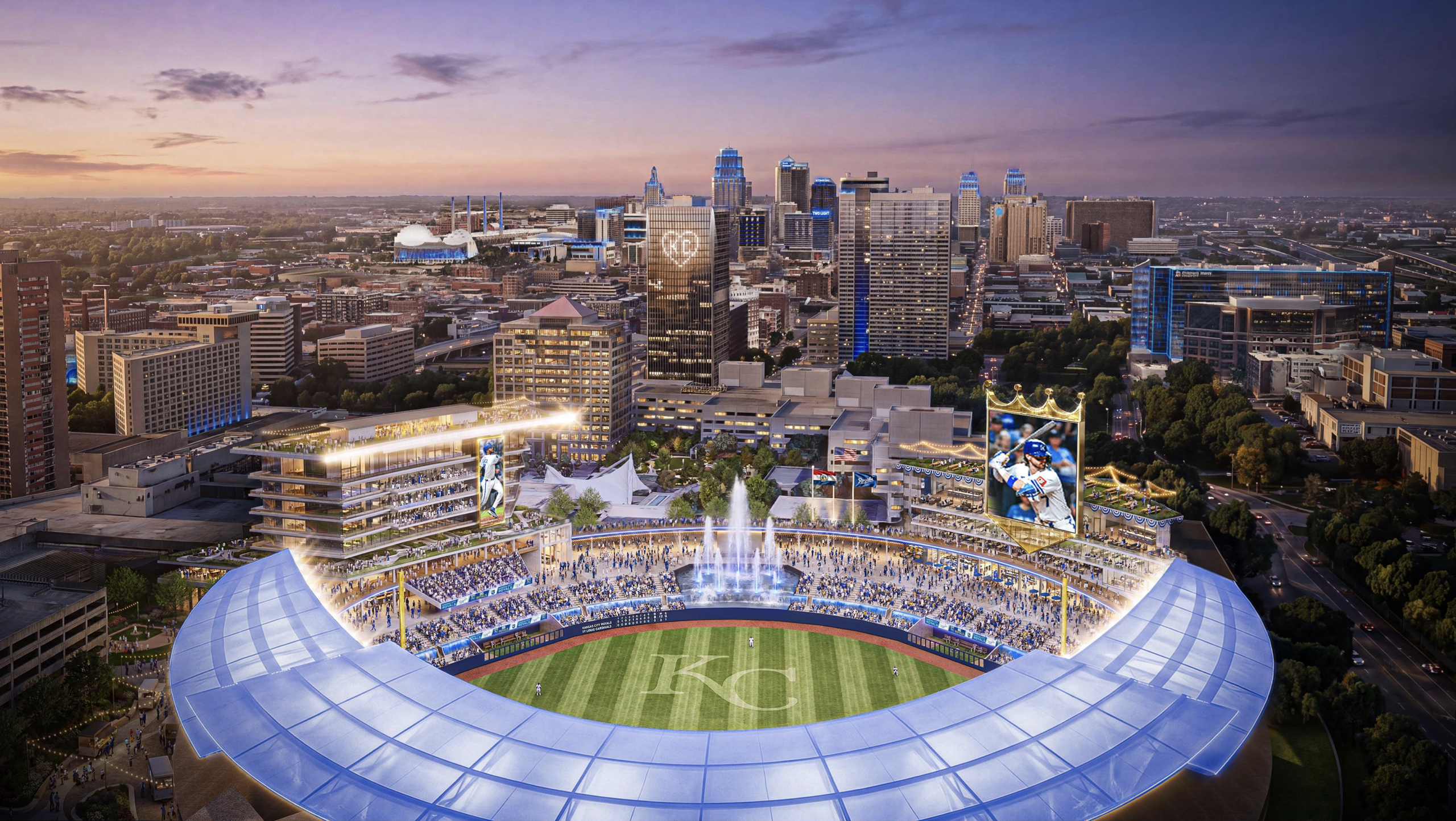
We read all 165 pages of the agreements Kansas City just signed. Here's what's in them.
The Kansas City Council approved the Royals stadium ordinance Thursday on an 11-2 vote, clearing the city manager to sign the lease, development, funding and community impact agreements for a new ballpark at Crown Center. Councilmembers Johnathan Duncan and Nathan Willett voted no.
The headlines covered the vote. The agreements themselves are public, free and posted on the City Clerk's website — and they contain a lot that didn't make the news.
THE MONEY
The lease sets rent at one dollar a year, plus 5% of the net profit the club keeps on non-baseball events like concerts. In exchange the Royals cover all cleaning, maintenance, repair and day-to-day operation of the building themselves, keep the naming and sponsorship money, put in $760 million of private cash, and eat any overrun above the $1.9 billion budget.
The public side totals $1.14 billion: Kansas City's $600 million — up to $90 million in cash for infrastructure, with the balance, roughly $510 million, in city-supported bonds — and about $540 million from the State of Missouri. That's 60% of the stadium covered by taxpayers.
Two details in the funding agreement worth knowing. The city's obligation is written as "unconditional" to the fullest extent Missouri law allows, contingent only on the Royals not defaulting. And if the state's contribution shrinks, the city's $600 million does not. The agreement says so explicitly.
WHAT FANS GET
Written straight into the contract: Kansas City residents get at least 25% off single-game tickets for designated regular-season games, the city gets 30 free tickets to every home game, and the city can use the stadium for eight of its own events a year — covering security, maintenance and event management costs, with the Royals permitted to charge reasonable fees for hosting.
THE DATE
Every rendering and press release points at a 2030 opening. The paperwork says something slightly different. The development agreement sets a hard substantial-completion deadline of March 30, 2031, with $35,000 a day in penalties past it, and the parties anticipate the lease commencing Feb. 1, 2031 — though the lease technically starts whenever the Royals begin baseball operations. Builders routinely write cushion into completion dates, so the gap isn't automatically a red flag. But March 2031 is the date that's legally enforceable and 2030 is the one being marketed.
THE COMMUNITY MONEY
The final agreement sets a minimum of $55 million over the life of the lease. Three pieces are named up front: $5 million to the Royals Foundation for youth sports, aimed at zip codes the KC Health Department flags as focus areas, the Royals Amateur Development Complex on Blue River Road, and fields at Clark Ketterman Park, Parade Park and Blue Valley Park; $5 million into the city's Housing Trust Fund for homelessness work; and $14 million to the Public Art Fund, which includes moving the 65-foot "KC Heart Gateway" sculpture from the World Cup into the ballpark plans or Washington Square Park.
The remaining $31 million is paid year by year, rising with inflation but capped at 2% annually. That pool is where several headline items actually live: the $5 million for the Negro Leagues Baseball Museum's capital fund, a second $5 million for youth sports, the Relocation Impact Area Account for neighborhoods losing the Truman Sports Complex, Washington Square Park upkeep, and the Union Station fixed-rail study.
Which means the $10 million Councilwoman Melissa Patterson Hazley secured on the floor Thursday is real, but it sits inside the $55 million. The total didn't move.
WHAT THE CLUB COMMITTED TO
For scale: that $55 million, spread across 30 years, comes against a $600 million city commitment — roughly nine cents back for every dollar the city puts in. Supporters counter that the stadium itself is the return, and that community benefits agreements this size are rare. What's in it:
The Negro Leagues Baseball Museum goes free every February for Black History Month. A veteran or active-duty service member is honored at every home game, first responders at six. Free field trips take elementary students to the ballpark, the Urban Youth Academy and the Negro Leagues Museum. There are scholarships for first-generation and underrepresented students, a work-study program at the stadium, direct contributions to teachers at city districts and charter schools, and Washington Square Park stays free, with the club paying programming and upkeep.
The club also signed up for rules covering the build — the terms neighbors will feel long before anybody throws a pitch. No construction before 7 a.m. or after 9 p.m. without coordinating first. Crews park off-site and shuttle in so they don't swallow the neighborhood's parking. Noise barriers, dust control and site cleanup are required. "Local Businesses Open During Construction" signage is literally written into the contract. The club must name a point of contact for complaints and post a progress update every two weeks to a public website. Contractors must pay prevailing wages and run apprenticeship programs. And there are specific protections for Hospital Hill, keeping patient and emergency vehicle access open through construction and on game days.
THE AMENDMENT
The one change made on the floor came from Patterson Hazley, 3rd District at-Large, who represents the district Kauffman Stadium has anchored for more than five decades. She secured $10 million from the Royals for urban core youth athletics, $5 million up front and at least $5 million more over the life of the agreement. In her statement she said she approached the relocation with "serious apprehension," focused on what replaces the asset the East Side is losing, and cited the labor agreement SEIU Local 1 won as a factor in her vote.
Source: Office of Councilwoman Melissa Patterson Hazley, Aug. 20, 2026
THE PART THAT ISN'T SETTLED
Here's what the council committed to without having in hand: a financial analysis showing how the $600 million gets paid back. The city commissioned a third-party study in April, but the results won't be public until after the agreements are signed and the city is legally on the hook for the number.
The deal is structured as tax-increment financing: new tax revenue generated by the ballpark and district goes toward the debt. Supporters argue that means the stadium pays for itself. But the city guarantees that debt, and the money runs through the general fund, the same account that pays for basic services. If the district generates more than enough, Kansas City comes out ahead. If it doesn't, the shortfall comes out of city services for the next 30 years.
There's a local precedent. Kansas City has paid out $167 million over 16 years covering Power & Light District debt, because it never generated enough on its own. "This is Power & Light on steroids," Duncan said at Tuesday's committee meeting. "To say that we're going to sign off and allow the city manager to execute all these agreements without the financial analysis, I think, is reckless."
Skipping a public vote also carries a price tag. The city is using special obligation bonds, which don't require voter approval but carry higher interest than voter-approved general obligation bonds — 5.725% versus 4.25% on bonds the city issued around the same time this year. Applied to $600 million, that gap runs roughly $7 million a year that could otherwise fund city services.
City Manager Mario Vasquez says the structure is about fairness, not avoiding voters: "General obligation is, in essence, a property tax levy to the entire community. So I don't think a property tax levy would be fair because the benefit is so concentrated into the stadium." He notes the city has data behind its projections: Crown Center activity jumps about 15% at Christmas, and the World Cup produced a measurable bump. One caveat even supporters acknowledge: not every dollar spent at the ballpark is new money. A fan eating at Crown Center instead of Waldo is a wash for city tax revenue.
THE OPPOSITION
The backdrop is a vote that already happened. In April 2024, Jackson County voters rejected a sales tax extension to fund a Crossroads ballpark, with the Royals and Chiefs each spending about $1 million campaigning for it. The Chiefs have since left for Kansas. Missouri Workers Power has pushed a petition to put the city's subsidy on the ballot — supporters filled the chamber Thursday in red shirts holding "Let the People Vote" signs — but city leaders believe the petition can't intervene once the agreements are executed.
Mayor Quinton Lucas has made the opposite case throughout. "The Royals and Hallmark downtown will bring millions of people to our city core, build thousands of jobs in the heart of our region and will extend benefits to every corner of Kansas City and our area," he said. "Great cities address issues in a number of different ways. And it doesn't mean that you are not addressing issues by also continuing to grow your city."
WHAT'S NEXT
Thursday's vote completes the city legislative process. It is not the last vote. Zoning authorization goes to the Council Thursday, Sept. 3. A Tax Increment Financing plan comes before the Council in the weeks ahead. City staff also continue working on applications in partnership with the State of Missouri. Patterson Hazley called Thursday's vote "the first step of many," noting that shared equity and shared financial responsibility talks are still open.
And one more date: all Major League Baseball approvals are due on or before Sept. 30, 2026. The Royals can't sign until MLB signs off.
Sources: City of Kansas City release (8/20) ·Visual Packet · KC City Clerk — Ordinance 260704 and all attachments